Reservoir theory

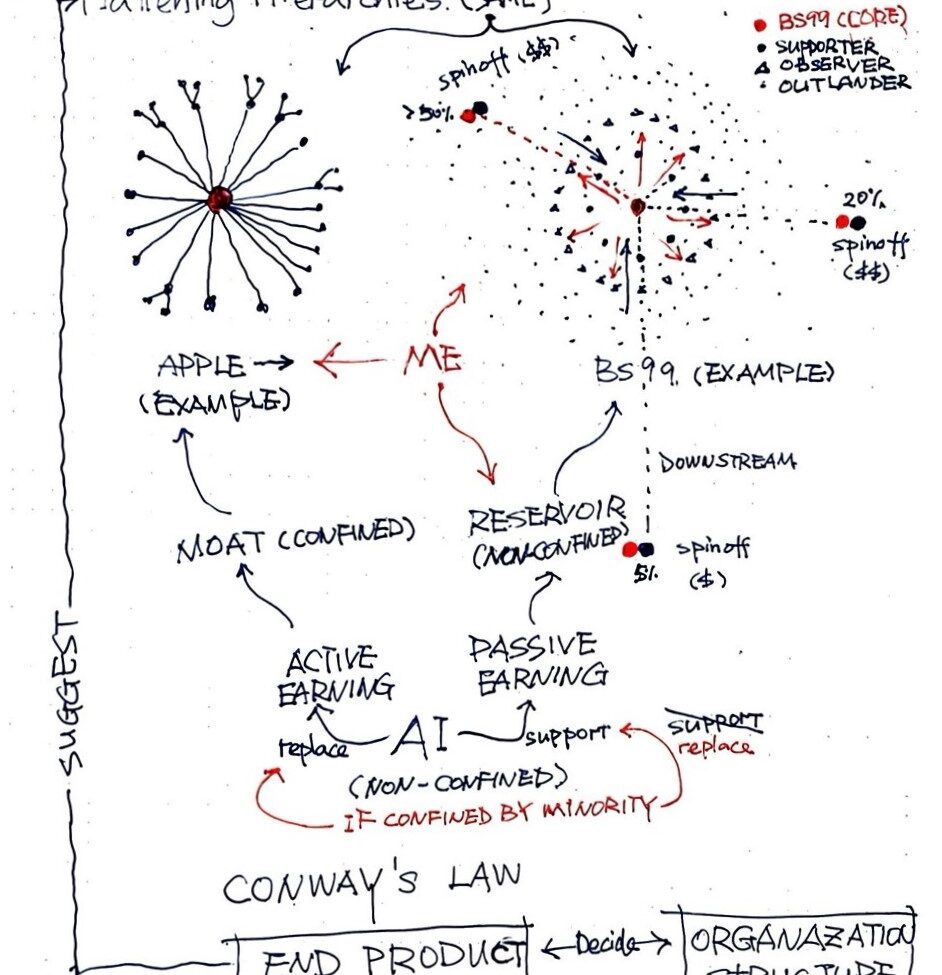
My friends know my enthusiasm for a future where AI isn’t restricted by minority. In this vision, I foresee AI will also reshaping how we think about earning: active income through human labor could increasingly be replaced by AI, we know that. But do we also see the potential for passive income to become mainstream? Think of earning money while you sleep through stocks or ETFs. Yet in the new AI era, I believe passive income could evolve into something different.
I named my intuitive concept the Reservoir theory, an open system where knowledge and prosperity flow freely, like water stored in a reservoir that nourishes downstream communities. Eventually, this shared prosperity returns to sustain the original source, creating a healthy, self-sustaining cycle.
However, this belief contrasts with the prevailing model of success for many companies (Apple included), which often follows Economic Moat (check out Buffett’s work if you’re unfamiliar with this idea). But, moat is about confining innovation within a competitive advantage, keeping technology proprietary to win the market. And yes, it works and drives profitability and market dominance. But does it sound familiar? Restriction by a few? I question whether the Economic Moat will survive when AI is not controlled by a select few.
A friend recently reminded me of Conway’s Law, and I found it fascinating. Entrepreneurs often see it as an argument for flatter management hierarchies, creating similar unified, powerful designs (again, think Apple). Conway’s Law says that the structure of an organization shapes the structure of its end product. Suddenly, all these pieces connected for me, forming a vision of the future. I’m excited to see that the Reservoir Theory could be the ultimate winner, provided, of course, that the core of AI remains open and unrestricted. So, as always, I sketched it out to capture my thoughts.
Copyright © 2024 BS99 – All Rights Reserved.